
Methane traps about 80 times more heat than CO₂ over 20 years.
Satellite AI for Indian landfill methane
Methane is invisible. VayuNetra makes it visible.
Satellite AI that finds, verifies and measures methane from India's landfills — and turns it into action.
- Scenes analysed
- 674
- Control false alarms
- 0 of 334
- Last scan
- 27 Dec 2025
- Worker
- offline
Live from the VayuNetra database
The problem
Landfill methane is large, fast-acting and mostly unmeasured
Landfill emissions in Delhi, Mumbai, Lahore and Buenos Aires were 1.4–2.6 times higher than earlier estimates.
Delhi's Ghazipur landfill caught fire. Fires and methane come from the same buried waste.
Source: CNN, April 2024
No one measures it landfill by landfill.
The invisible signal
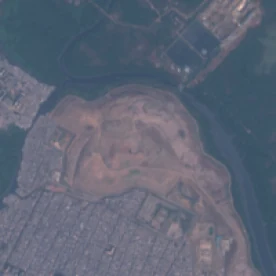
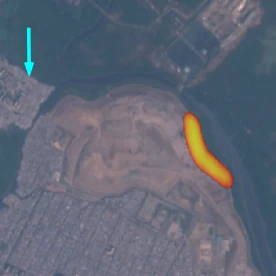
Deonar landfill, Mumbai, 6 January 2025
Sentinel-2's true-colour view of Deonar. The landfill mound, the creek and the city around it look ordinary.
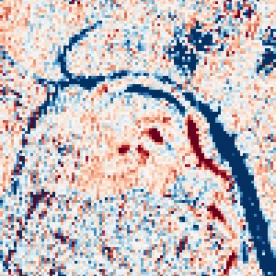
Methane dims one infrared band by only a few percent. The eye cannot see it; the retrieval and the model can.
T1T1 methane-confident: about 20.2 t/h (68% range 15.1–25.0 t/h), wind 5.1 m/s. Unconfirmed: queued for a hyperspectral check.
Screening-grade satellite estimate: confirm with a hyperspectral satellite, an OGI drone or a ground survey before enforcement or carbon crediting.
Scroll or use the buttons to move through the evidence
How it works
From a free satellite pass to an action dossier
01
Sentinel-2 pass
Free Sentinel-2 imagery arrives about every 5 days. Every new pass over a site is cut into a chip around the landfill.
02
MBMP retrieval
The multi-band multi-pass method compares the two shortwave-infrared bands with earlier clean passes of the same place.
03
AI segmentation
A U-Net with a ResNet-50 encoder, pretrained on Sentinel-2 (SSL4EO-S12) and trained on 3,552 real plumes plus simulated ones, outlines the plume and scores the scene.
04
Physics gate
Methane darkens band 12 strongly, band 11 weakly and visible light not at all, and a plume lies along the wind. Fires, moisture and fresh waste fail these tests.
05
kg/h with uncertainty
The plume's integrated mass and the ERA5-Land wind give an emission rate with a 68% range. In calm wind no rate is reported.
06
Action dossier
Each site gets a dossier with the evidence, the rate and the next step for MoHUA, CPCB/SPCBs and the municipal corporation.
Proof
Global benchmark on held-out test sites
VayuNetra against the classic MBMP method, scored on sites the model never saw in training.
ROC AUC
Recall by emission rate (t/h)
Plume outline (pixel IoU)
Emission rate within ±50%
At the operating threshold: precision 0.779 vs 0.602, recall 0.303 vs 0.144, false-alarm rate 8.6% vs 9.6%.
Every accuracy figure and matrix, in one place →India field test
Five landfills, two years, a control point beside each
January 2024 to December 2025. Each landfill has a control point 5 km away that should never show a plume.
- clear Sentinel-2 scenes
- 674
- control false alarms
- 0/334
- landfill flags
- 14
- T1 · T2 · T3
- 1 · 2 · 11
Site 1 of 5 · Delhi, Delhi
Ghazipur
69 passes · 3 flags
Flagged pass
T3 surface change, rejected as methane
12 June 2025 · moisture · Wind 3.4 m/s
- Control point 5 km north: 0 flags in 68 passes
- Persistent emission above 5 t/h would have produced more flags (95%).
The physics gate
Fourteen flags, sorted by physics
VayuNetra checks itself before it alerts anyone.
Every landfill flag goes through the same spectral and wind tests. Most turn out to be the landfill's surface changing, not methane.
Methane-confident
0Deonar, 6 Jan 2025
T1 · passes the spectral and wind tests
Probable, needs confirmation
0Okhla, 29 Nov 2024
T2 · near-miss on one test
Bhalswa, 18 May 2025
T2 · near-miss on one test
Surface change, rejected
0Deonar, 31 May 2024
T3 · moisture
Ghazipur, 12 Jun 2025
T3 · moisture
Pirana, 2 Dec 2024
T3 · fresh waste
Okhla, 4 Dec 2024
T3 · fresh waste
Bhalswa, 13 May 2025
T3 · moisture
Okhla, 10 Oct 2025
T3 · moisture
Okhla, 10 Oct 2024
T3 · fresh waste
Deonar, 22 Mar 2025
T3 · moisture
Okhla, 28 May 2024
T3 · moisture
Ghazipur, 20 Oct 2025
T3 · burn scar
Ghazipur, 28 Apr 2025
T3 · burn scar
From detection to action
What the Deonar dossier asks for
Deonar's minimum time-averaged rate is 301 kg/h, a minimum estimate of about 71,000 t CO₂e per year (GWP100 = 27).
- 01
Confirm
Task a hyperspectral satellite or fly an OGI-camera drone over the flagged cell.
- 02
Capture the gas
Wells and a header on the flagged cell. At 60% capture: about 41,900 t CO₂e avoided per year.
- 03
Generate power
About 0.9 MW electric, worth about ₹3.8 crore a year.
- 04
Carbon credits
About $419,000 a year from the avoided emissions.
Assumptions
- minimum rate 301 kg/h
- capture 60%
- flare/engine destruction 98%
- GWP100 27
- CH₄ heating value 50 MJ/kg
- engine efficiency 35%
- tariff ₹5/kWh
- carbon price $10/t
All values are assumptions and editable in the dashboard settings.
Open the Deonar dossier (PDF)
Screening-grade satellite estimate: confirm with a hyperspectral satellite, an OGI drone or a ground survey before enforcement or carbon crediting.
Honest by design
A free screener, then a confirmation
Tier 1: free screener
Sentinel-2, every new pass, every site. Finds candidates and rules out most surface changes.
Tier 2: confirmation
Hyperspectral satellite, OGI drone or ground survey on the flagged cell.
Enforcement or carbon crediting
Persistent-emission upper bounds (95%)
A steady emitter at or above this rate would have produced more flags than we saw.
- Ghazipur≤ 5 t/h
- Bhalswa≤ 5 t/h
- Deonar≤ 10 t/h
- Pirana≤ 10 t/h
- Okhla≤ 20 t/h
Limits, stated plainly
- Over dense Indian landfills a single pass catches about 25–35% of plumes of 10 t/h or more.
- Below 1 t/h the model finds 9% of plumes.
- Fine-tuning on Indian backgrounds did not improve held-out detection (AUC ≈ 0.55). The limit is the Sentinel-2 signal against dense urban backgrounds, which is why VayuNetra has two tiers.
- In a known-truth test on an Indian background, the estimated rate was 0.98× the injected rate at 10 t/h.
- The Deonar T1 event stays unconfirmed until the hyperspectral check.
- Every rate on this page is screening-grade.
The film
VayuNetra in five minutes
Our initiative
Why we built VayuNetra
Landfill gas can be captured and burned for power, but only where someone has found it. Sentinel-2 is free and passes over every Indian city about every 5 days. We built VayuNetra to turn those passes into site-by-site evidence a municipal corporation or pollution control board can act on.
Team
Team lead: Jiyad Hussain, Amity University, Noida. Built for the Net Zero AI Architecture hackathon.
Open source
The code is MIT-licensed on GitHub: the worker, the database schema and this website.
View on GitHubAlignment
- Swachh Bharat Mission-Urban 2.0 targets legacy dumpsite remediation.
- India's net-zero target is 2070.
Roadmap
- 01
5 landfills
Delhi, Mumbai and Ahmedabad, with control points
- 02
50 dumpsites
Legacy dumpsites in the remediation programme
- 03
State-wide monitoring
Every new pass, every site in a state
Partner with us
For municipal corporations, SPCBs and CPCB: we will screen your sites and share the dossiers.